This article provides a basic legal overview of how the Slovak Land Registry (kataster) categorises land and why understanding these data is key to any investment or construction plan. The author explains the structure of land-type codes and categories under the Cadastral Act and its implementing decree — from agricultural land, through forests, to water areas. She highlights the risks of a passive approach when buying and stresses that a buyer cannot rely on the formal entry in the Land Registry alone, but must verify the parcel's real legal potential against the municipality's planning regulations before signing the purchase contract.

Whether you plan to build a house, invest in land or realise the value of inherited property, every process begins with examining the title deed (list vlastníctva). The Land Registry (kataster) is the first place that reveals whether your dream plan is consistent with the legal position. Many owners see the entries on the title deed as mere formal boxes, but in reality it is your property's "birth certificate", precisely defining what you may — and, conversely, may not — do on it. It is the land type and its manner of use that are among the key parameters determining whether your investment plan is realistic and lawful.
In the following text, we look at how the Land Registry categorises land and why it is essential to understand these rules before taking any legal step towards purchasing property.
When dealing with land, it is essential to know its type under the Cadastral Act and the associated decree. The land type and its location determine the legal limits on its division, consolidation, change of use, potential future construction and tax burden.
When looking at a title deed, it is crucial to understand that the entries in it are not arbitrary. While the Cadastral Act sets the basic legal framework and defines which land types exist in our country, the implementing decree and the methodological guidelines of the Geodesy, Cartography and Cadastre Authority of the Slovak Republic go into greater depth. They determine in detail the manner of land use and lay down clear rules on which combinations are legally permissible. Put simply: .
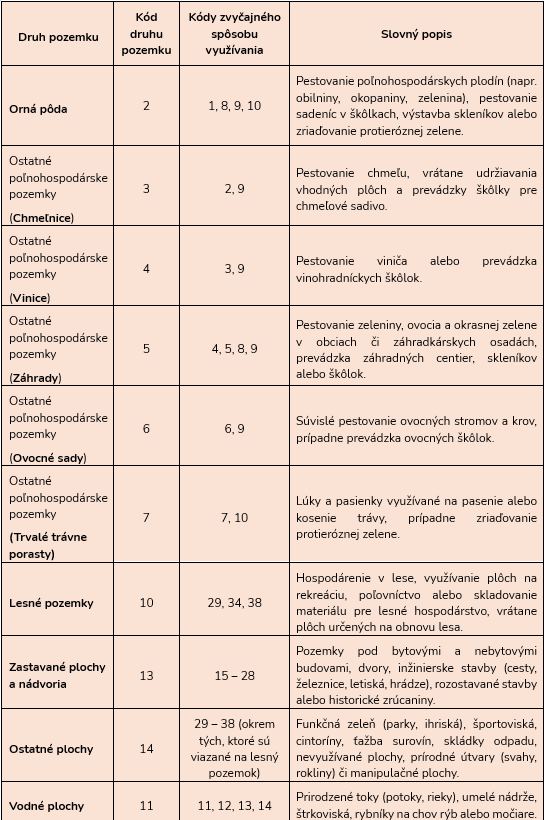
Under § 9 of the Cadastral Act and Annexes 1 and 2 to Decree No. 461/2009 Coll., the following land types and manners of their use are distinguished:
Yes — a plot's legal status is not immutable, but changing it is subject to strict rules. In practice, the most common effort is to change arable land into a built-up area for individual construction. This process, however, does not begin at the Land Registry. The basic condition is conformity with the municipality's zoning plan, followed by the withdrawal of the land from the agricultural land fund. Until these steps are completed, the land remains agricultural in legal terms, which makes it impossible to obtain a decision on the construction project.
Before signing a transfer contract, it is critical for the buyer not only to check the current state of the Land Registry, but also to obtain planning information (územnoplánovacia informácia, 'ÚPI') from the municipality. Although the ÚPI is only informative in character, it is the first essential indicator of whether your specific investment plan is even permissible in the given location under the zoning plan. If, for example, you are planning a guesthouse in a zone designated exclusively for family houses, terraced housing on the edge of a municipality, or a smaller development project, it is precisely the municipality's regulations that will determine whether your plans fail at the very outset. A legally sound review of these limits before any contractual obligation arises is the only way to avoid buying a property on which you will not be able to realise your plan.
Legal services:
Uncertainty when buying land can cost you both time and money. We will be glad to help you with a comprehensive legal audit of the property and handle communication with the authorities before any contractual obligation arises.
Contact us for a no-obligation consultation today.