Are you planning a development project or an industrial hall, or do you simply need to consolidate agricultural land? Learn how simplified land consolidation (jednoduché pozemkové úpravy, "JPÚ") works under § 8c to § 8e of Act No. 330/1991 Coll., who bears the costs of financing it, and when it is conditional on compliance with the municipality's planning documentation.

If you are planning to launch a development project, build an industrial hall, or simply put the ownership of agricultural land in order at last, classic (comprehensive) land consolidation would be far too long a road for you. Fortunately, Slovak legislation offers a more flexible tool: simplified land consolidation (jednoduché pozemkové úpravy, "JPÚ").
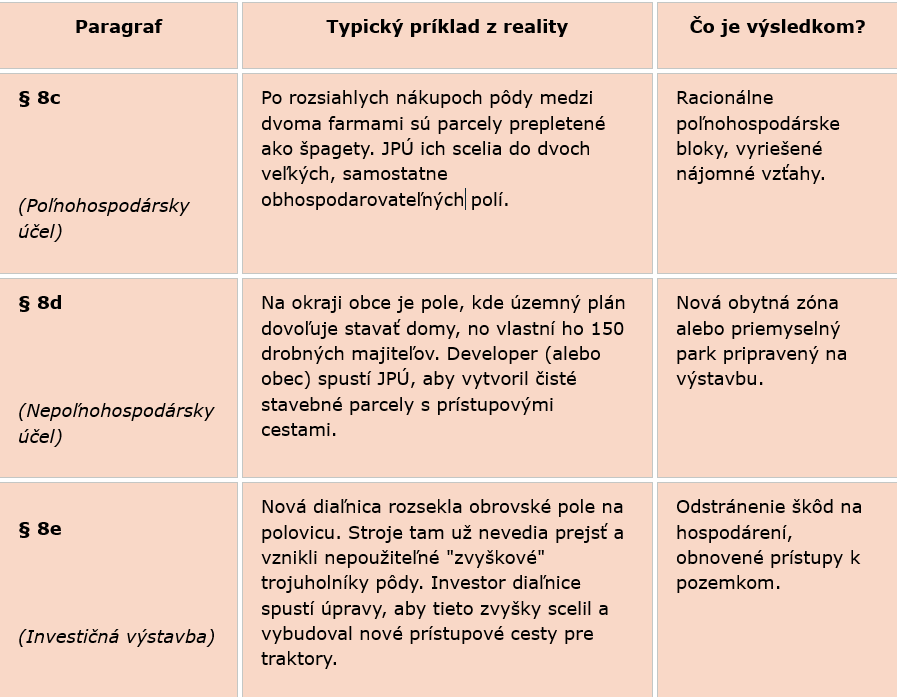
Although they share a common goal – to consolidate and tidy up fragmented plots – the Land Consolidation Act divides them, in § 8c, § 8d and § 8e, into three entirely different worlds. These three regimes are not an exhaustive list of all types of simplified land consolidation, but they are the "statutory routes" most frequently used in practice. Each of them addresses a different life situation, has a different initiator and different rules of the game. Let us look at how to navigate them and which type you need for your project.
At the outset it is important to be clear about the goal of the land consolidation in your area: will the land remain predominantly agricultural/forest land, is it being prepared for future construction use, or is a major construction (e.g. a motorway) entering the area?
This type of simplified land consolidation is used where significant changes in ownership and use relations are occurring, but the land is to continue being used for agriculture or forestry. The aim is above all to consolidate fragmented plots, improve access to them and make plot boundaries more logical – not to turn them into building plots. For an owner it typically means "fewer strips, clearer boundaries, better access".
Depending on the type of simplified land consolidation involved, who acts as the applicant or investor, and who must initiate the proceedings before the district office, also changes.
In practice these will be entities such as the National Motorway Company, the Railways of the Slovak Republic, energy and transport undertakings, or the investor in a strategic park. The key point for owners is that the costs of reorganising ownership and use relations where a major construction intervenes are borne by the investors, not by ordinary landowners.
The link to land-use planning determines how strict the conditions are that you must satisfy even before filing an application for simplified land consolidation.
For a client this means that a clear land-use planning basis (or the substitute mechanism under the Act) is an indispensable condition for the district office to be able to authorise simplified land consolidation under § 8d at all. This is not a separate construction-permitting process, but a verification that the JPÚ project complies with the planning documentation (or its substitute).
Land consolidation is a costly process (the project, surveying, expert valuations, technical measures, legal representation). In practice, the Act leads to the costs being borne, in general, by the party for whose benefit the consolidation is carried out, while at the same time protecting the owners through a compensation mechanism.
At-a-glance summary: Typical examples from practice
Simplified land consolidation is an extremely effective tool, but success depends on getting the start right. If you know exactly what your goal is (making a farm more efficient, building a district, or remediation after infrastructure construction), you can choose the right legislative procedure and avoid unnecessary delays before the authorities.
Are you preparing simplified land consolidation? Set up the right legal framework from the outset – consult VLKOVÁ, advokátska kancelária, before filing your application.