You are negotiating an important deal, investing in legal services and expert reports, and at the last minute the other party backs out without any relevant reason? Read how Slovak and Czech courts assess pre-contractual liability (culpa in contrahendo), when you are entitled to compensation for damage, and how to protect yourself with pre-contractual agreements.

Imagine the situation: You have spent weeks negotiating a deal, the purchase of land, or a commission for a piece of work. Everything is going well, the last details are being fine-tuned, and on the basis of this legitimate expectation you invest money: you pay for legal services, document translations and expert reports, you prepare materials or reserve working capacity and turn down other offers. And then, just before signing, the other party says without any reasonable ground: "I've changed my mind, I'm not signing the contract."
Many people assume that as long as the contract has not been signed, neither party bears any legal responsibility for the course of the negotiations. The legal reality is different. This institution is known as pre-contractual liability (in Latin, culpa in contrahendo). Although Slovak law contains no general express regulation of it, in certain cases protection can be sought through the general provisions on compensation for damage and the principles of private law. Since Slovak case law deals with this issue only marginally, our analysis draws on older Czech decision-making practice, which addresses comparable situations.
If someone frustrates the signing of a contract at an advanced stage, you may suffer damage. The recoverable costs most frequently recognised by Czech case law (e.g. Supreme Court of the Czech Republic, file no. 25 Cdo 337/2015, of 26 October 2016) include:
Courts naturally respect the autonomy of will, so no one can be forced to conclude a contract if . However, for pre-contractual liability to arise, Czech decision-making practice (e.g. Supreme Court of the Czech Republic, file no. 29 Odo 1166/2004) examines in particular whether the following circumstances are met:
Since Slovak law lacks a specific provision expressly defining culpa in contrahendo, Slovak courts resolve these situations through the general provisions on compensation for damage and the principles of private law. Decisions in which courts assess dishonest conduct prior to concluding a contract on the basis of the general damages provisions are, however, still relatively rare (Supreme Court of the Slovak Republic, file no. 3 Cdo 78/2009).
In practice, this means that if someone breaks off negotiations with you without justification, the courts most often rely on a combination of three provisions of the Slovak Civil Code:
Certain exceptions and specific rules for the business environment can nevertheless be found in the Slovak Commercial Code. These concern in particular the misuse of confidential information (§ 271 of the Slovak Commercial Code) and the situation where damage arises as a result of the invalidity of a contract (§ 268 of the Slovak Commercial Code). In most ordinary cases of arbitrarily backing out of a deal, however, we have to rely on court decisions and the general rules on compensation for damage.
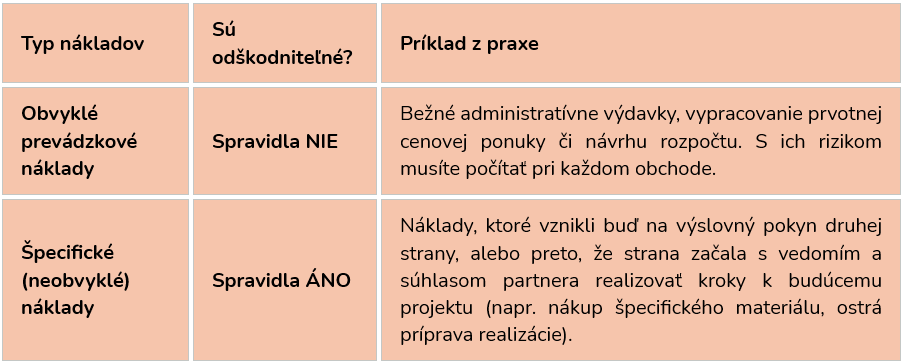
According to Czech decision-making practice, an important distinction between types of costs applies in pre-contractual liability disputes under the older Civil Code regime (Supreme Court of the Czech Republic, file no. 23 Cdo 836/2021):
Pre-contractual liability is not only about the sudden and groundless termination of negotiations, but also about what happens to the information you exchanged during them. If information provided during negotiations is designated as confidential, or is evidently confidential from the circumstances, the law prohibits you from using it for your own benefit or passing it on to a third party (under § 271 of the Slovak Commercial Code). If you breach this, your contractual partner may claim compensation for the resulting damage under § 373 et seq. of the Slovak Commercial Code, even if the final contract was never signed.
Contact us in time and together we will set up the legal framework for your negotiations.